
Series
Hive Series
Machined honeycomb geometry in a warm natural finish with brass hardware.
View details
Process
Membranes, shells, air, and the things that move between them.
Details
Overview
A stick hits a head. The head moves.
Then everything else starts answering.
Air, shell, hardware, edge, stand, room.
The head is the obvious resonator.
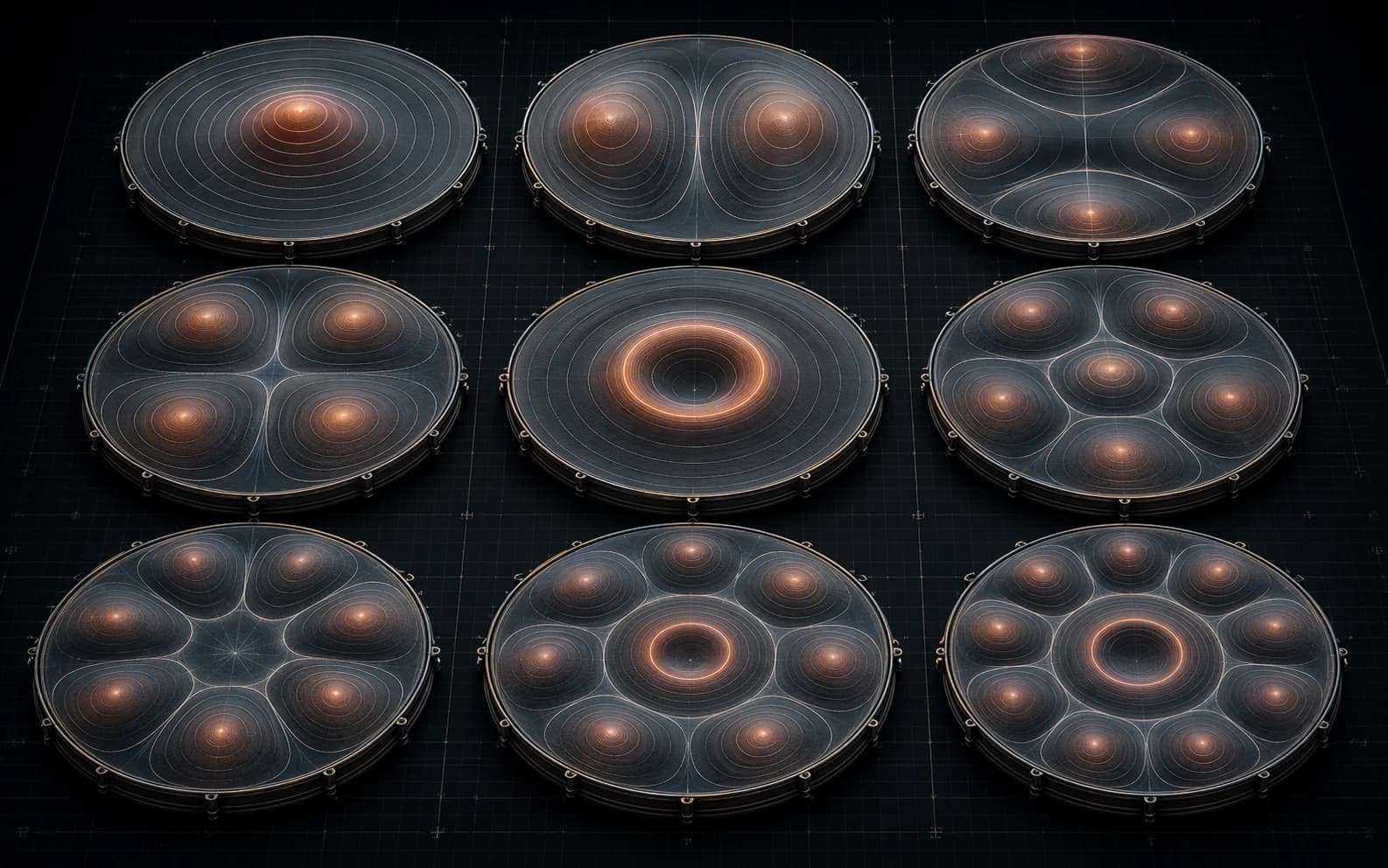
A stretched circular membrane moves through families of modes, each with its own shape and frequency.
Those frequencies are not neat multiples. The drum speaks more as timbre than pitch.
The membrane has order.
A real strike rarely excites only one shape.
Real heads are not ideal circles in a textbook.
They bend. They load against air. They meet a shell, a stand, a second head.
The batter and resonant heads meet through the air volume.
One resonance can split into two nearby behaviors: more in phase, more out of phase.
Shell, air, edges, hardware.
Not one resonator. A coupled object.
The shell is not the head.
But it is not silent. Its modes can sit near the places where the heads are active.
A shell has shapes of its own.
They help decide how much the shell joins the instrument.
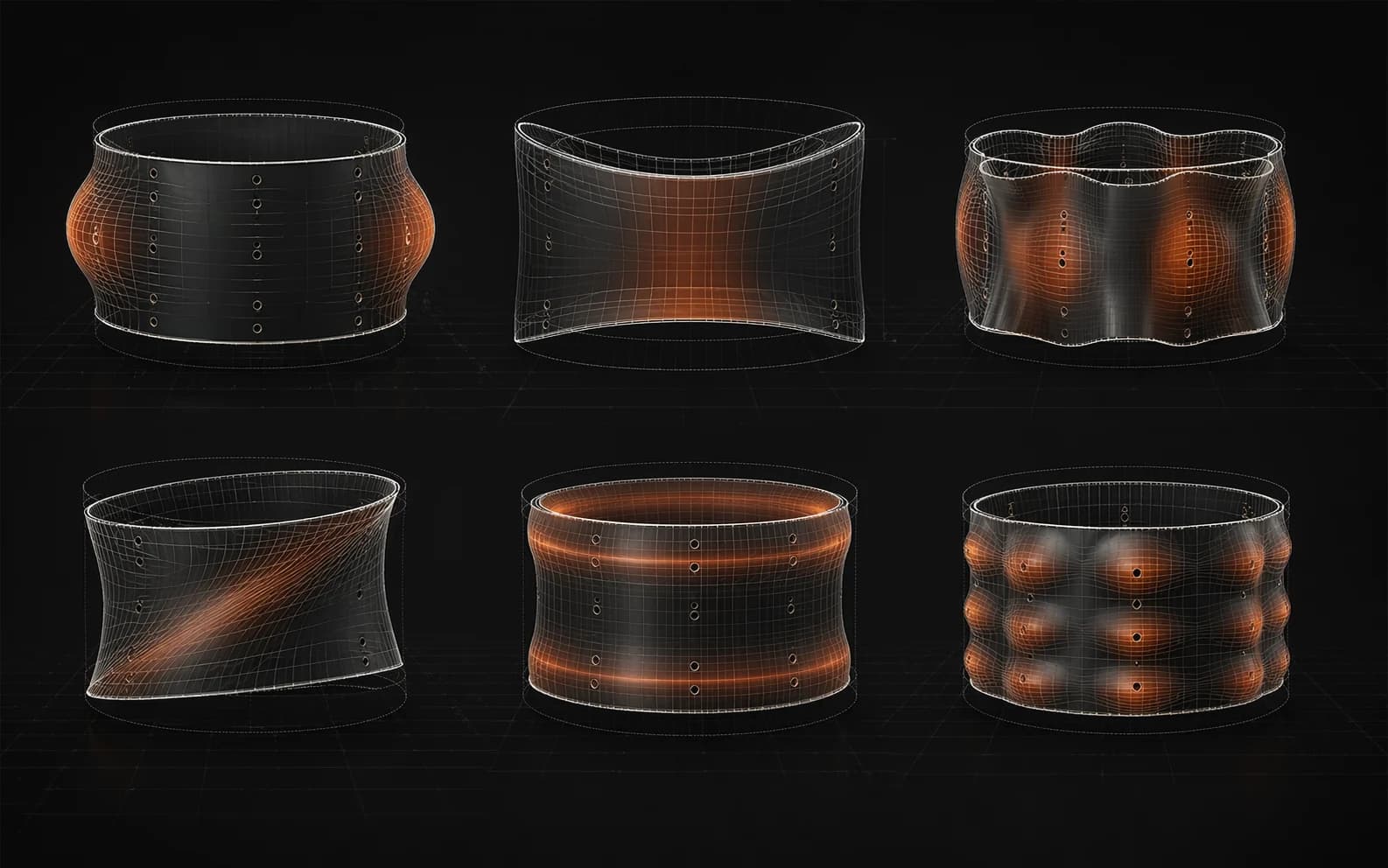
Thickness, stiffness, mass, radius.
Change them and the shell modes move.
A very rigid shell can hold the heads and stay mostly out of the way.
A lighter, more compliant shell can move closer to the living part of the spectrum.
That changes feel.
A machined surface changes mass and stiffness locally.
It changes how the shell bends, stores, and releases energy.
Where are the shell modes?
How strongly do they participate?
What does that do to the whole drum?
A shell can do more than hold a membrane.
Lower mass, lower effective stiffness, and machined surface geometry let the shell participate.
Multiple resonators, answering at once.
The useful question is where they are, how they couple, and what kind of instrument that creates.
Bibliography
Primary papers and references used throughout the essay.
A concise overview of drum acoustics and membrane behavior.
Helpful for thinking about circular membrane mode shapes.
Models the coupled behavior of membranes, air, and snares.
Useful for shell damping and shell participation in a snare system.
The shell-mode shapes and thickness discussion come from this paper.
Related object