
Hardware
Robot Lug One
A compact composite lug system.
View details
Field guide / Chapter 06 of 06
Lugs and throwoffs add mass where the shell moves. Here is what that does.
Details
Overview
Lugs, the throwoff and the butt plate are all screwed through the shell wall.
Ten solid brass lugs can outweigh the maple shell they are bolted to.
Lighter hardware leaves the shell freer to move.
When the shell flexes, everything bolted to it has to move with it.
To the shell, that hardware is extra mass at fixed points around its circumference. How much, and where, changes how the shell behaves.
Fig. 8
Mass at the wall lowers every shell mode, just as taking mass out of the wall raises them. It also makes the shell harder to set moving: the same push from the heads moves it less.
What counts is hardware weight compared with shell weight. The lighter the shell, the more its hardware matters, which is why a machined shell and light hardware belong together.
Shell modes, bare vs with hardware
Evenly spaced lugs look the same to most shell modes, whichever way the mode turns. The exception is the mode whose bulges line up with the lugs: the five-lobed mode on a ten-lug drum, the four-lobed mode on an eight-lug drum.
Turned one way, every bulge carries a lug. Turned the other, every lug sits on a still point. The two versions ring at different pitches. Set the throwoff to zero in Fig. 8, then switch between 8 and 10 lugs and watch the split move.
A throwoff on one side and a butt plate on the other are heavier than a lug, and they are not evenly spaced. That lopsided mass splits every shell mode a little, the same way uneven head tension splits head modes in Chapter 05.
It can also cancel a split. On ten lugs, a 132 g Throwoff One sits between two lugs, right where the five-lobed mode was light. It nearly evens that mode out while splitting the others. Mass placement is a tool as much as mass itself.
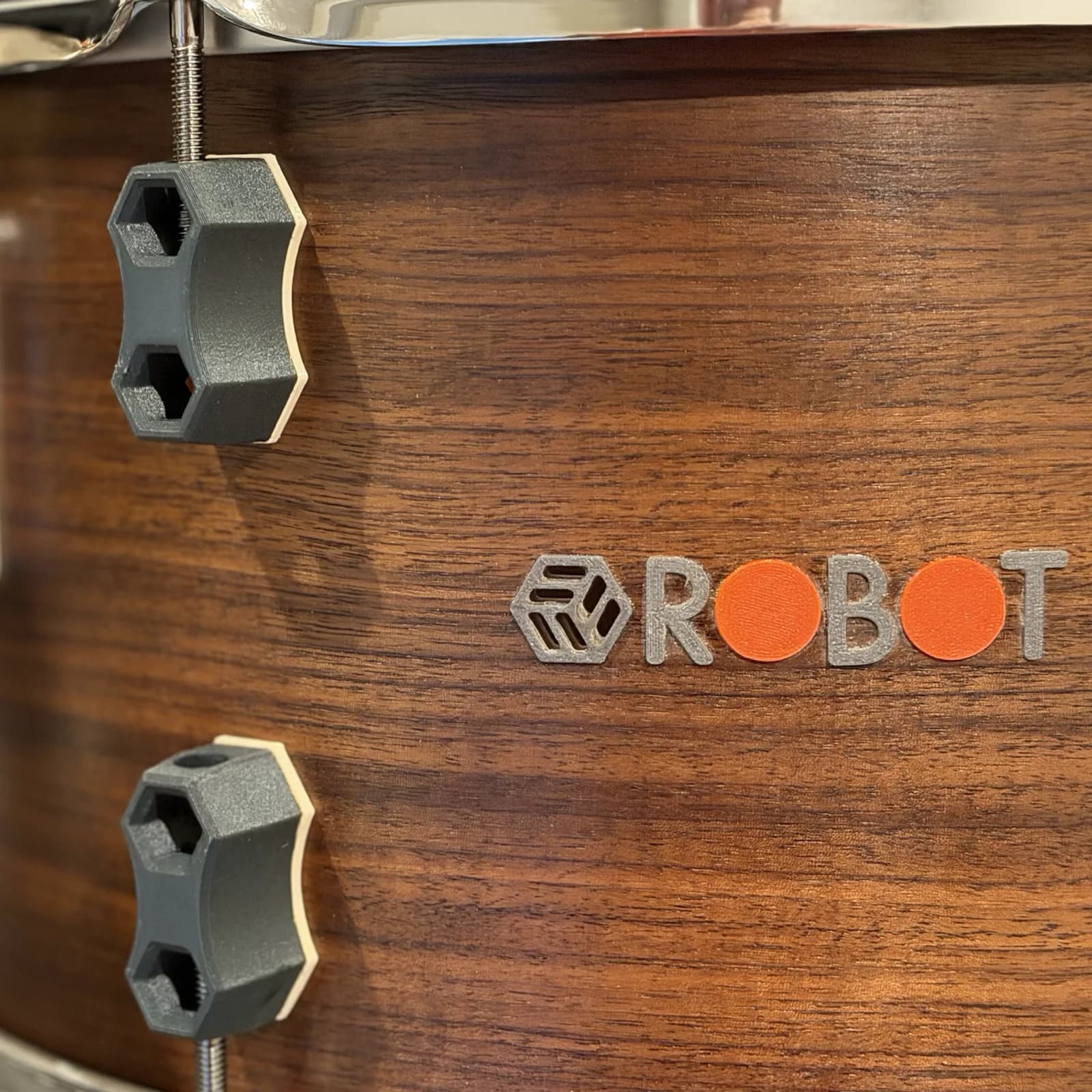
Robot Lug One exists in two versions of the same design. Machined from solid brass it weighs 118 g, about as heavy as a lug gets. Printed in glass-fiber-reinforced composite it weighs 17.5 g.
On a 14 × 6.5 maple snare with ten lugs, that is 1,180 g of brass against a 930 g shell, or 175 g of composite. With a Throwoff One (132 g) on both, Fig. 8 has the brass lugs pulling the oval mode down by more than a third and leaving the shell moving about two-thirds as far. With printed lugs the mode drops 17%, and about half of that comes from the throwoff and butt plate.
Neither is wrong. Brass makes a heavier, more held-down drum. Composite leaves the shell free to take part in the sound, which is the drum the rest of this guide describes.
Bibliography
Primary papers and references used throughout the essay.
The standard reference for membranes, shells and coupled vibrating systems.
Related object