
Series
Kumiko Series
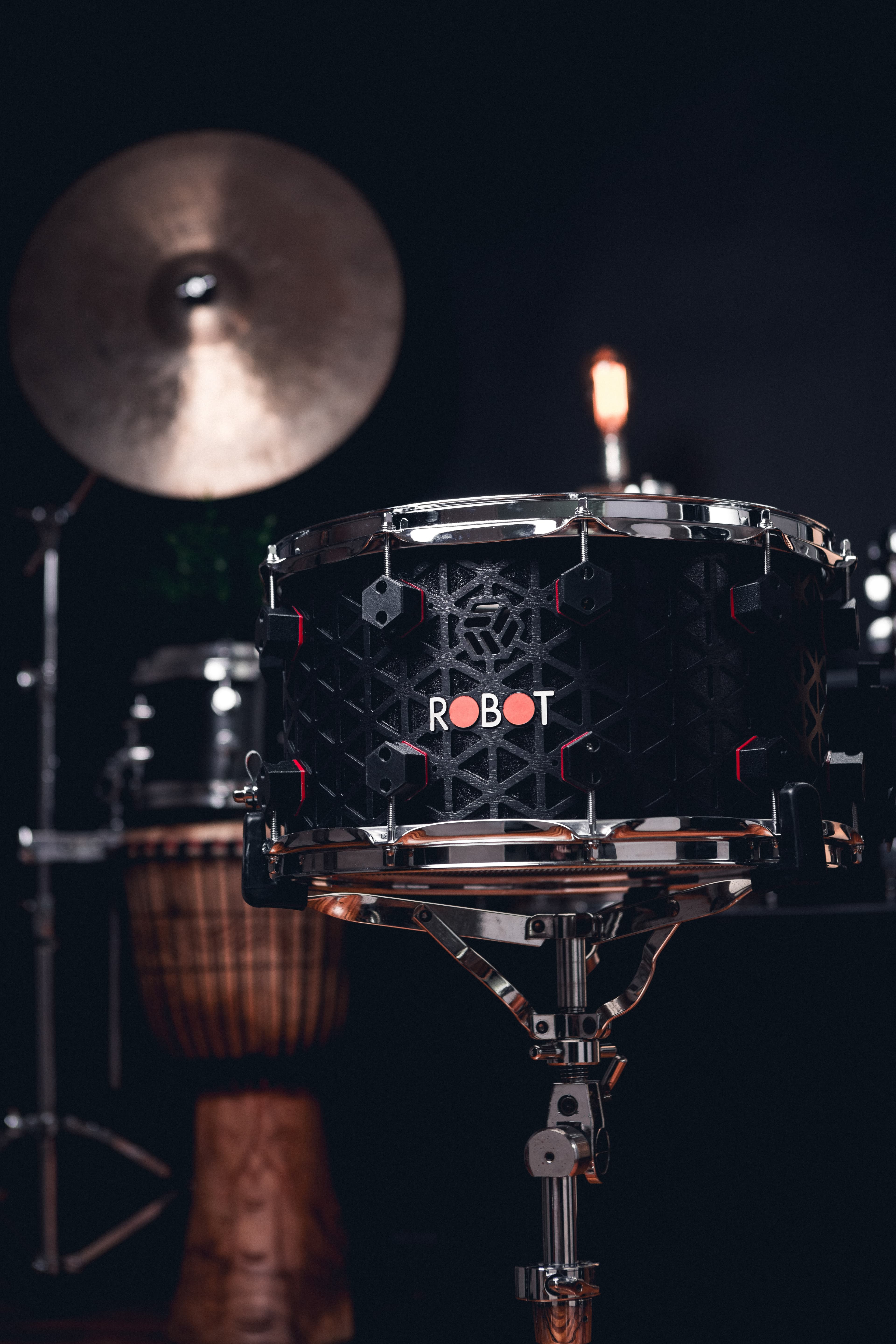
Black and Honey Wheat drums with a CNC-machined isogrid shell and open response.
View details
Field guide / Chapter 04 of 06
Cutting an isogrid into 10-ply maple, and what it changes.
Details
Overview
A machined pattern is not a finish.
It changes the shell's mass and stiffness, so it moves the shell's modes.
Depth and rib width decide by how much.
Fig. 4
A Kumiko shell starts as a 10-ply maple shell. The isogrid is cut into the outside: triangular pockets through some of the outer plies, with ribs left standing between them.
Every pocket takes mass out of the wall. Every rib left behind keeps some stiffness.
| Shell | Mass | Stiffness | Oval mode | n=3 | n=4 | n=5 |
|---|---|---|---|---|---|---|
| Plain shell7.2 mm, 10 plies | 930 g | 100%bending | 95 Hz | 268 Hz | 515 Hz | 833 Hz |
| Machined5 of 10 plies cut | 703 g-24% | 49% | 77 Hz-19% | 217 Hz-19% | 416 Hz-19% | 673 Hz-19% |
| Same weight, thinner5.4 mm solid | 703 g-24% | 43% | 72 Hz-24% | 203 Hz-24% | 389 Hz-24% | 630 Hz-24% |
Where the shell modes sit against the heads
Dashed: plain shell. Orange: machined shell. Shell modes n = 2 to 5.
A shell's modes go up with stiffness and down with mass. Take out mass alone and they would rise. Take out stiffness alone and they would fall.
A pocket takes out both. The deeper the pocket, the lighter and less stiff the wall. What depth changes is the balance between the two, and that balance is the design lever.
Ribs in three directions, 60° apart, resist bending equally in every direction. The shell stays even under the hoop and the lugs.
Square or one-way ribs would make the shell stiffer one way than the other. Aerospace uses the same triangle grid to stiffen panels for the same reason.
A machined shell has to keep material where it carries load: at the bearing edges, and under the lugs and throwoff.
Fig. 4 assumes the pattern covers about 80% of the shell, with full-thickness bands left for those jobs.
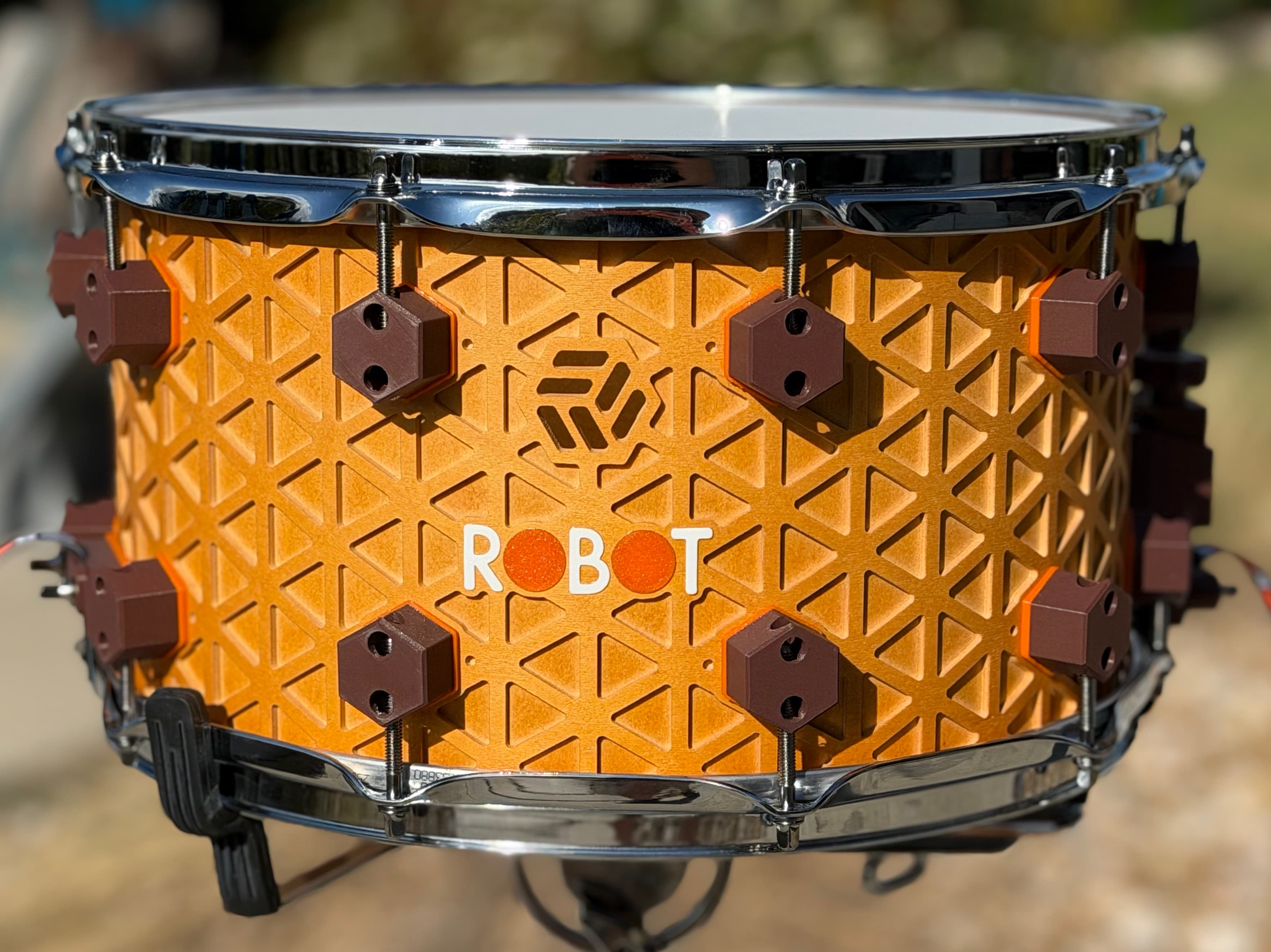
A machined shell is mechanically rewritten. The pattern you see is the change you hear.
That is the idea behind the Kumiko, Hive and Asanoha shells: geometry that looks like what it does.
Bibliography
Primary papers and references used throughout the essay.
Shell mode shapes, and how thickness and reinforcement move them.
The standard reference for membranes, shells and coupled vibrating systems.
Related object