
Interactive essayOctober 23, 2026
The Head Is the Voice
Modes, nodal lines, and why a drum is a color more than a note.
Read
Field guide / Chapter 03 of 06
The shell has modes of its own. What matters is where they sit.
Details
Overview
The shell is not the head, but it is not silent either.
It has its own modes, fixed by its mass and stiffness.
When the heads land near them, the shell joins in.
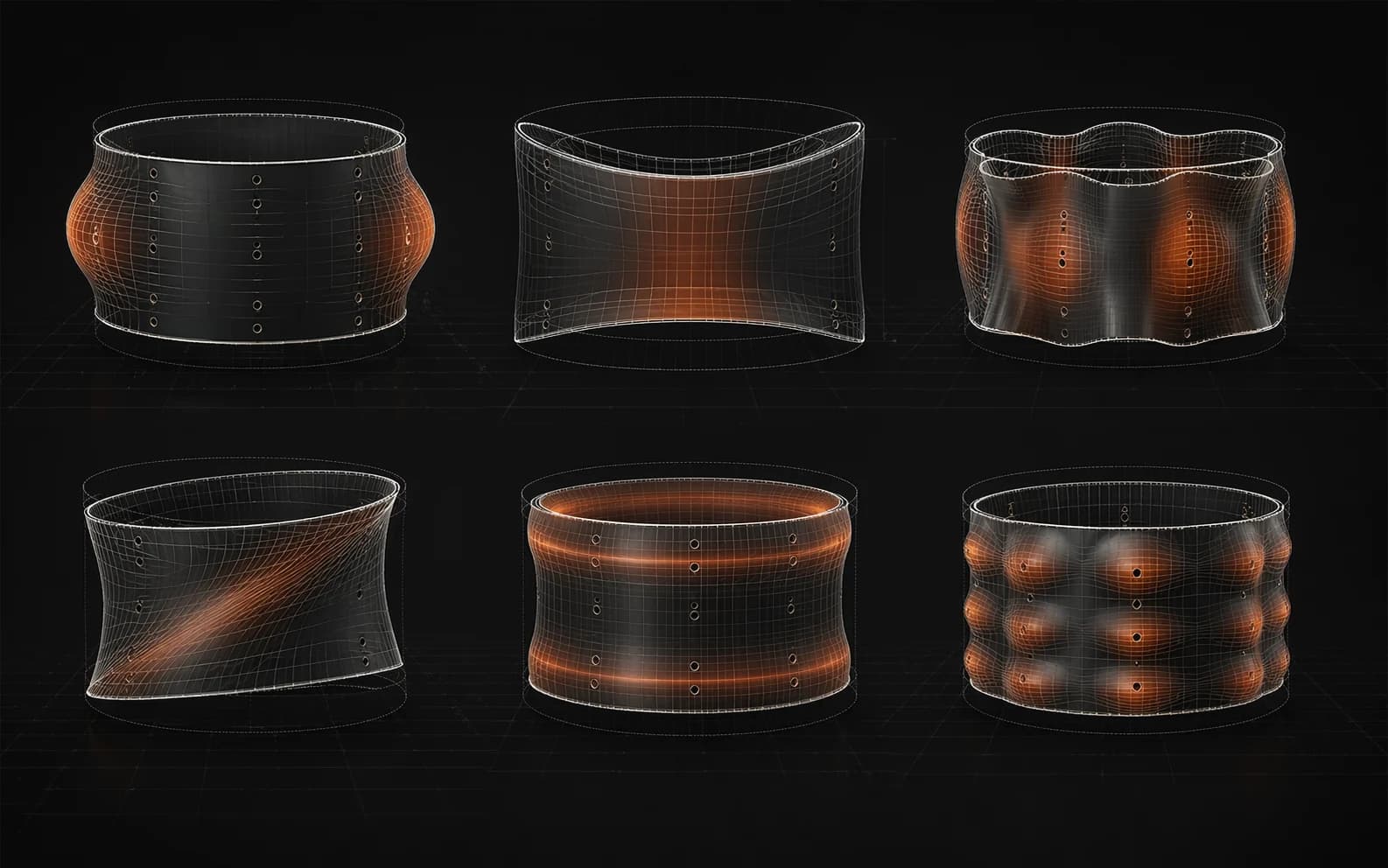
Tap a bare shell and it rings. Like the head, it has modes: it goes oval, then three-lobed, then four-lobed, each higher than the last.
Those frequencies come from the shell itself: wall thickness, stiffness, mass and diameter. Tuning the heads does not move them.
Fig. 3
The heads' modes move every time you turn a lug. The shell's stay put, so as you tune, head modes slide past shell modes.
When one lands close to a shell mode, the two trade energy. The shell rings along, that part of the sound gets more body, and the head mode often dies a little sooner because it is sharing its energy.
Most drummers know a drum that comes alive in one tuning range and goes flat in another. Part of that is the heads meeting the shell's modes. Part is the two heads meeting each other through the air.
A shell does not have one sound. It has a set of places where it agrees with the heads.
Wood, glue lines, finish and hardware all soak up vibration. A heavily damped shell joins in briefly and lets go. A lively one keeps ringing with the heads.
Neither is right. They are different instruments.
A very stiff, heavy shell holds the heads and mostly stays out of the way.
A lighter, more compliant shell moves its modes down toward the range where the heads are working, and joins the sound. We design for that: a shell that takes part on purpose, in places we chose.
Bibliography
Primary papers and references used throughout the essay.
Shell mode shapes, and how thickness and reinforcement move them.
Measured shell modes and how strongly the shell takes part in a snare.