
Interactive essayOctober 23, 2026
How a Drum Makes Sound
One hit, followed from the stick to the room.
Read
Field guide / Chapter 02 of 06
Modes, nodal lines, and why a drum is a color more than a note.
Details
Overview
The head does most of the talking.
It moves in a family of fixed shapes, each with its own pitch, and those pitches do not line up.
Where you hit it decides which shapes you hear.
Fig. 2
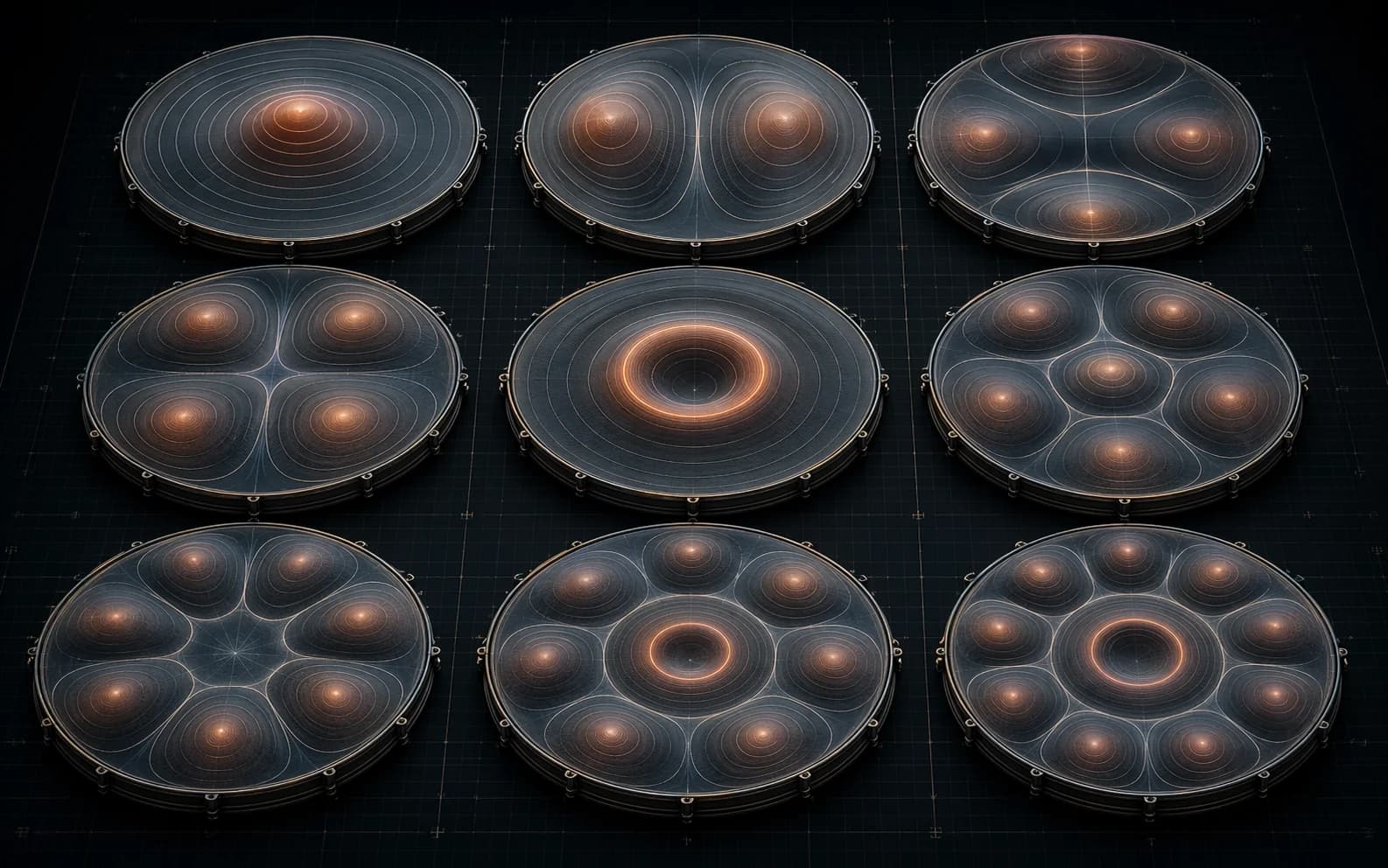
A stretched circular head can vibrate in a set of fixed shapes called modes, each at its own frequency.
Some modes move the whole head up and down together. Others split it into halves, quarters or rings that move in opposite directions. The lines between those parts, where the head does not move at all, are nodal lines.
On a guitar string the overtones fall at whole-number multiples of the fundamental: two, three, four times. That is what gives a string a clear pitch.
A drumhead's modes land at 1.59, 2.14, 2.30 and 2.65 times the fundamental. The ear hears a cluster rather than a note, which is why drums get tuned for color and feel more than for pitch.
A mode can only be driven where it moves. Every mode with a nodal line across it stands still at the center, so a center hit drives only the round modes. The sound is fuller, shorter and more focused.
Move toward the edge and the other modes join in. The sound gets thinner, brighter and longer. Try it in Fig. 2.
Tightening a head raises every mode by the same ratio. Frequency goes up with the square root of tension, so doubling the pitch takes four times the tension.
Head weight works the other way. Heavier film lowers everything and takes the edge off the highest modes.
A real head is loaded by the air on both sides, stiffened at its collar, and coupled to a second head and a shell. The pattern of modes survives. The exact numbers move.
Which brings us to the shell.
Bibliography
Primary papers and references used throughout the essay.
A concise overview of membrane modes, air loading and two-headed drums.
How real, non-uniform membranes depart from the ideal mode shapes.