
Interactive essayOctober 23, 2026
The Head Is the Voice
Modes, nodal lines, and why a drum is a color more than a note.
Read
Field guide / Chapter 01 of 06
One hit, followed from the stick to the room.
Details
Overview
A stick hits a head. Within a few milliseconds the whole drum is moving.
This chapter follows that one hit through the head, the air, the second head, the shell and the room.
Every figure here is live. Hit it, tune it, listen.
Fig. 1
Slow a drum down enough and the sequence is easy to follow.
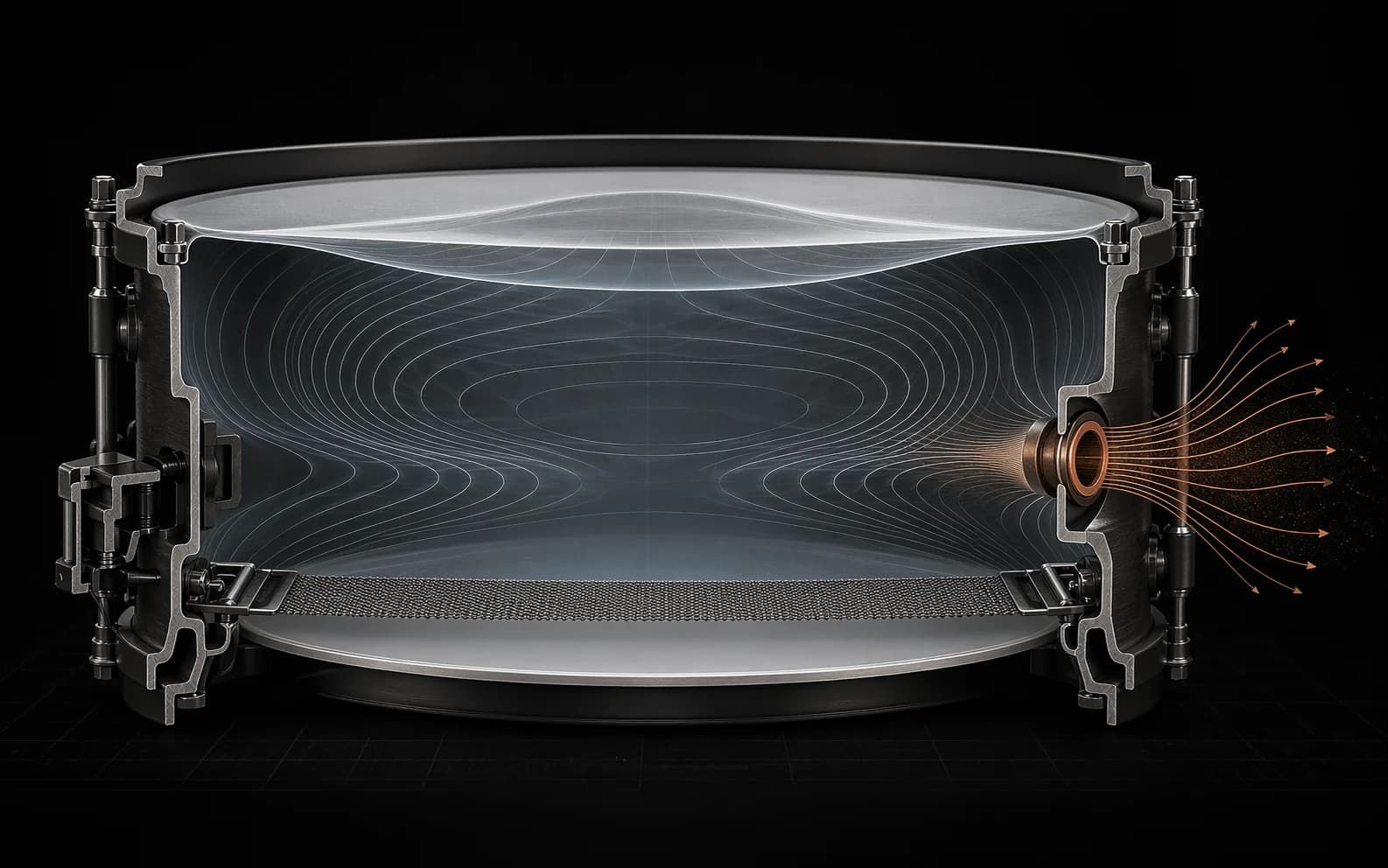
The stick hands the batter head a short burst of energy. The head bows inward, springs back past flat and keeps going. Each swing squeezes and stretches the air sealed inside the shell.
That air acts like a spring. It pushes on the resonant head, which starts to move too, and then pushes back on the batter head.
On its own, each head has a fundamental set by its tension, its size and its weight.
Put both heads on a shell and the air joins them. They stop ringing at their own pitches and ring together at two new ones: one with the heads moving together, one with them moving apart.
That is why changing the resonant head changes the note you hear from the batter side, and why the same heads sound different on a deeper or shallower shell.
A vent lets some of the squeezed air escape instead of pushing on the other head.
The heads pull on each other less, the low end loses some push, and the decay changes shape. Size and placement decide how much.
Run Fig. 1 sealed, then vented, and watch the pressure inside.
Every squeeze of the air also pushes outward on the shell. It flexes a little, and it has shapes of its own that it prefers to move in.
How much the shell joins in depends on where those shapes sit compared with the heads. Chapters three and four are about exactly that.
The heads are large, light and moving a lot, so they push most of the sound into the room. The shell's share is smaller and shows up as color: which overtones last and which die early.
Then the room takes over. Walls, floor and microphone decide what the hit sounds like by the time it reaches you.
Bibliography
Primary papers and references used throughout the essay.
Models two membranes coupled through the enclosed air.
A concise overview of membrane modes, air loading and two-headed drums.